 The Business of Surgery
 As part of a special series on artificial intelligence (AI), OR Manager is taking a deep dive into the many facets of this new technology and its impact on patient care. In this issue we continue our examination of the challenges related to AI, which began in last month’s issue…
Current endoscope reprocessing methods are not consistently effective in eliminating organic soil or microbes, and the off-label use of products for defoaming, lubrication, and bleeding control may be contributing to reprocessing failures. Though endoscope manufacturers have cautioned against the use of these products, endoscopists still commonly use them, and many…
Our series on artificial intelligence (AI) concludes in this issue with part 2 of an in-depth look at legal and ethical questions (cover story) as well as advice for evaluating new AI products (“Consider all angles when choosing AI technology,” p 13). But insights about future trends like AI do…
Innovative technology and surgical procedures, including artificial intelligence, will be explored in depth during the OR Manager Conference, September 18-20 in New Orleans. The new OR of the Future gives attendees a unique opportunity to learn through interactive experiences, educational sessions, and discussions with leading experts: product manufacturers as well…
This article concludes OR Manager’s special series on artificial intelligence (AI). Parts 1 and 2 (May 2019 and June 2019) introduced AI, defining the different types of technology and describing its many current and potential applications for surgery. The series also presented examples of AI (June and July 2019). We…
Surgeons are the biggest factor in any effort to streamline and standardize the purchase of new surgical devices—and thereby lower costs. But surgeons often balk at getting involved in product review and selection because of the additional demands on their time. Two leading healthcare organizations have moved past this stumbling…
As part of a special series on artificial intelligence (AI), OR Manager is taking a deep dive into the many facets of this new technology and its impact on patient care. Part 1 and Part 2 of the introduction to AI (May 2019 and June 2019) defined types of AI…
The Leapfrog Group’s spring 2019 Hospital Safety Grade Report shows some progress in patient safety: an estimated 160,000 avoidable deaths nationwide, down from 205,000 in 2016. But 160,000 is a large number. “There’s still a lot of needless death and harm in American hospitals,” says Leah Binder, Leapfrog’s president and…
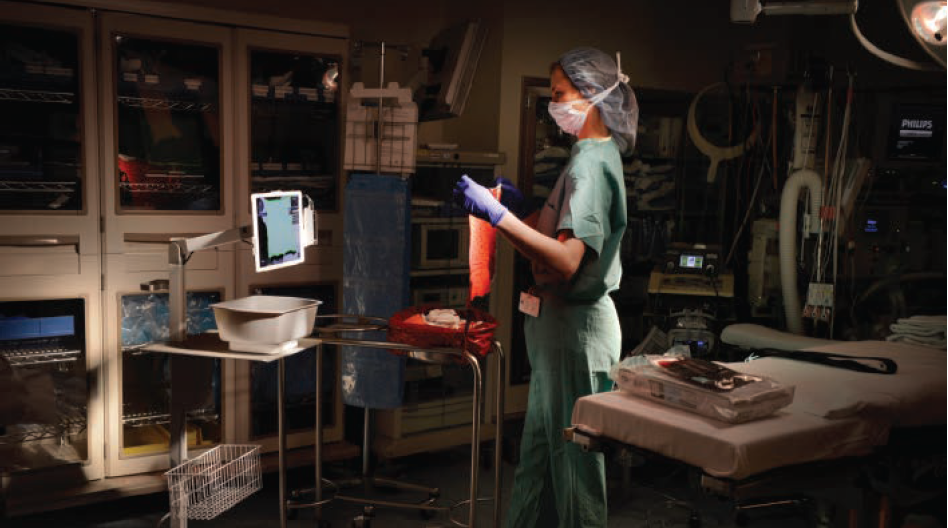
Blood loss during labor and delivery (L&D) and surgical procedures can lead to serious complications that might be prevented with early detection; however, detection can be challenging. For example, clinicians have traditionally estimated blood loss visually—a subjective and often inaccurate process. Humans’ eyes simply aren’t good at making precise measurements,…
OR leaders spend much of their day ensuring the surgery schedule runs smoothly, a task that depends on the teams within each of the ORs. Highly functioning teams produce optimal results, including good patient outcomes, satisfied surgeons, and efficient use of resources. But developing a highly functional team with good…