Editor's Note
New clinical guidelines emphasize that safe and equitable perioperative care for transgender and gender-diverse (TGD) patients hinges on affirming communication, tailored medical assessments, and culturally competent practice. According to a peer-reviewed article published in the June issue of Nursing, perioperative teams must adopt evidence-based, inclusive approaches to better serve the estimated 1–1.4 million TGD individuals in the US—a population disproportionately affected by healthcare discrimination and poor outcomes.
The article outlines comprehensive guidelines that address every phase of perioperative care, from patient identification and communication to intraoperative and postoperative management. The authors stress that TGD patients often avoid care due to past experiences of harassment, misgendering, and inadequate treatment. These disparities are linked with elevated rates of depression, HIV, substance use, and suicide. In surgery, TGD patients face heightened clinical risks, including complications tied to hormone therapy, anatomical differences from gender-affirming procedures, and psychological distress. Failing to recognize these factors can result in substandard care, with long-term impacts on patient trust and safety.
Respectful patient identification—including the use of affirmed names and pronouns—is central to reducing harm and fostering trust. The authors recommend trauma-informed communication strategies, such as introducing one’s own pronouns and minimizing misgendering. They also urge clinicians to avoid “deadnaming” and to verify preferred terminology alongside legal documentation.
Medical considerations are equally critical. Preoperative assessments should include a detailed gender history, current hormone therapy, and relevant surgical procedures. The article notes that standard risk assessment tools may not apply accurately to TGD patients and advises comparing lab results using affirmed gender reference ranges if hormone therapy has been ongoing for 6 months or more. Pregnancy testing should be considered in transgender men with retained reproductive anatomy.
Intraoperatively, clinicians must anticipate airway challenges resulting from facial procedures or hormone-related anatomic changes, and take precautions with estrogen patches due to thromboembolism risks. Gender-affirming surgeries, such as vaginoplasty or phalloplasty, may also impact urinary catheterization, requiring early consultation with urology.
Postoperatively, multimodal pain management strategies are recommended, with attention to hormone effects, potential substance use, and psychosocial support. The article advocates for involving patients’ chosen support networks and using interdisciplinary care models similar to those in transplant or bariatric surgery to improve outcomes.
Finally, the authors emphasize the need for ongoing institutional and individual cultural competency training, noting that affirming care begins with self-awareness, education, and a commitment to dismantling bias. Hospitals should integrate trans-specific education into clinical training programs to ensure readiness and reduce disparities in surgical care for this patient population.



When: Monday, March 16, 2026 · 1:00 p.m. Eastern Time
About
Surgery coordination can be fragmented, time-consuming, and error prone due to multiple parties needing to confirm case details through a wide variety of channels. Surgeons can spend more time than they wish outside of the of the operating room due to prolonged OR turnover times. This can be partially due processes that include excessive amounts of equipment needing to be broken down, cleaned, and set up after each case. Excessive instrumentation can lead to increased case costs.
In this webinar Dr. Robert B. (RB) Jones with Mercy Orthopedics will review how he used Advance Case Management (ACM) in his practice to:
This has enabled Dr. Jones to run a more efficient operating day. Dr. Jones currently reports over 1,300 Arthroplasty cases per year, and with utilization of Advance Case Management he aims to add to that number, and even drive efficiency and case cost reduction.

Dr. Robert B.(RB) Jones
Orthopedic Surgeon, Mercy Springfield
Dr. Jones specializes in adult reconstructive orthopedic surgery of the hip and knee. He performs routine and complex primary and revision joint replacement operations. Additionally, his focuses include direct anterior total hip arthroplasty and partial knee replacements. He considers himself very lucky to have a profession that he is passionate about and blessed to be able to help others doing what he loves.
Nate Edgington DBH, MHI, MBA
Senior Manager, Field and Customer Solutions, DepuySynthes
Nate Edgington is a seasoned leader in the MedTech industry, with over 20+ years’ experience working in the US and overseas. Nate has held various roles with DePuy Synthes as a group manager and more recently a regional manager for the Advance Case Management Platform. Nate has a doctorate in healthcare management and a master’s degree in healthcare innovation from Arizona State University and an MBA from Taylor University.

When: Tuesday, December 2, 2025 · 12:00 p.m. Eastern Time
About:
This webinar will dive into the importance of utilizing antifog surgical masks in clinical settings, examining how the risk of mask fogging can compromise the safety of healthcare providers and patients. Attendees will gain a comprehensive understanding of surgical masks, what antifog is, and what types of antifog technology are currently available in the market. The Cardinal Health hydrogel surgical mask will also be introduced, and its many features and benefits will be detailed.
Meet the Speakers:

Annie Copeland, Global Marketing Director, PPE, Cardinal Health
Annie resides in Massachusetts and has been with Cardinal Health for 8 years. With a degree in English and Marketing from Assumption University, she has held various roles across sales and marketing serving various customer segments. In her current role at Cardinal Health she leads both portfolio strategy and commercial execution for PPE. With a keen focus on clinical insight and customer needs, she aims to deliver a portfolio of PPE products known for reliable performance, designed for comfort and delivering ongoing value.

Bridget Stovall, Global Medical Advisor, Cardinal Health
Bridget currently resides in Green Bay, Wisconsin, and has worked for Cardinal Health for about a year. With a BSN from St. Ambrose University, she has a strong work history as a bedside nurse, a Clinical Nurse Leader, an Inpatient Nurse Manager, and now as a Global Medical Advisor. In her current role, she provides clinical expertise and serves as the subject matter expert to support product design, change management, and risk mitigation through product lifestyle. She serves as a clinical consultant and works to align clinical practice, product usage, and user needs.

When: Wednesday, December 3, 2025 · 1:00 PM ET
About:
This continuing education session explores the critical role of double gloving in enhancing safety for both surgical patients and healthcare workers. Participants will gain evidence-based insights into the risks associated with undetected glove perforations and the link between glove integrity and surgical site infections (SSIs). The program reviews recently published literature and consensus recommendations to highlight the benefits of double gloving with an indicator system and changing gloves at specific intervals including improved detection of glove breaches, decreased transmission of bloodborne pathogens, and reduced infection rates.
Meet the Speaker:

Carlo Butacan, BSN, RN, CNOR, Clinical Specialist, Molnlycke Health Care.
After completing his Bachelor’s in Psychology at Loyola University Chicago and obtaining a Bachelor’s in Nursing from Lewis University in Romeoville, IL, Carlo has dedicated over 17 years to his career as a registered nurse, primarily specializing in the surgical field. His extensive experience includes actively participating in various procedures, with orthopedics being his preferred focus. This hands-on involvement, both in scrubbing into surgeries and circulating, laid the groundwork for his professional growth.
Carlo transitioned into roles in Quality and Business Management for Surgery, ultimately leading him to his current position as a Clinical Nurse Specialist at Molnlycke. In this role, he is enthusiastic about applying his accumulated knowledge and, most importantly, serving as an educator. Despite his demanding career, Carlo still manages to find time to explore new restaurants in his hometown of Chicago, IL, as well as travel abroad.
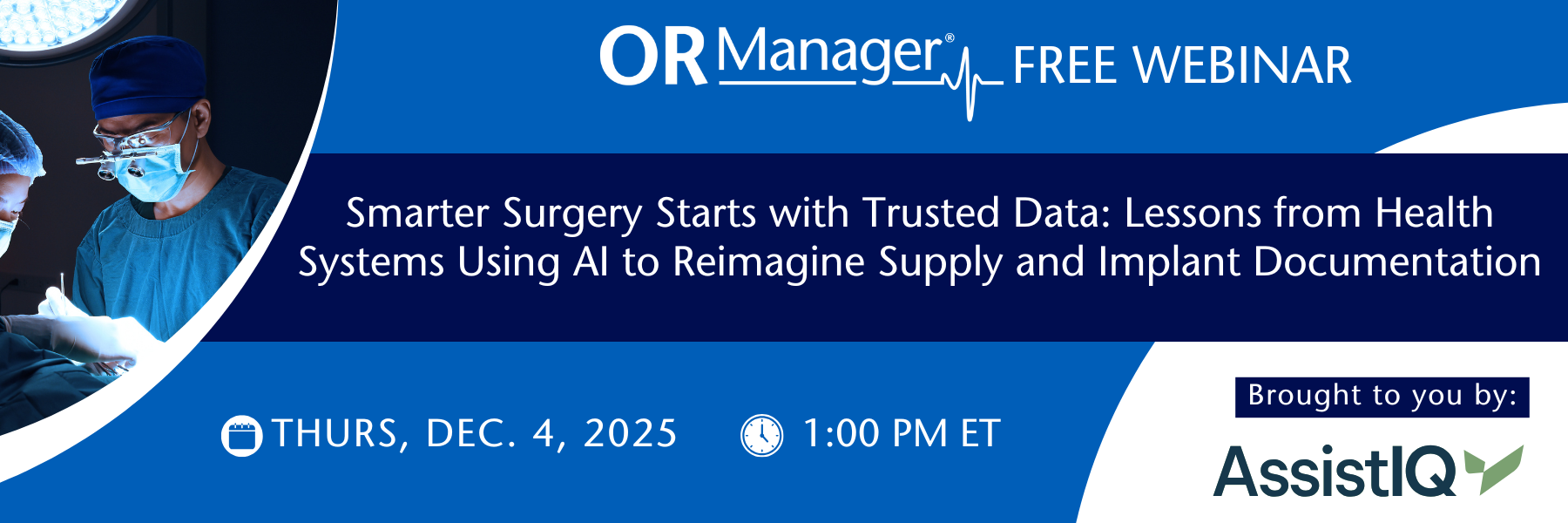
When: Thursday, December 4, 2025 · 1:00 p.m. Eastern Time
Perioperative teams are navigating tighter margins, staffing strain, and new reimbursement pressures such as OBBBA—all while relying on manual and ineffective systems that weren’t built for today’s demands.
Join AssistIQ and health system leaders for a candid roundtable on how hospitals are reimagining supply and implant documentation with AI-powered capture. Panelists will share why they adopted this approach, what implementation looked like, and the measurable impact they’ve seen so far.
“We have a financial ROI. We’ve been on it for six months, and we’ve been able to have a 12% increase in billable revenue and a 50% reduction in expired items.” -Beth Steele, Chief Operating Officer, Owensboro Health Regional Hospital
“Our care team members feel the difference right away. Instead of dealing with barcode scans that may not register or having to manually document, our teams can capture every product quickly and accurately while keeping their focus on the patient.” –Matt Pavlovec, Patient Care Manager, Allina Health
Meet the Speakers:

Amy Brown, MHA is the Director of Customer Delivery at AssistIQ, where she leads implementation and customer success. With a background in healthcare operations, Amy previously worked within Surgical Services at OhioHealth Riverside Methodist Hospital before gaining product and technology experience at a healthcare startup. She brings a deep understanding of perioperative workflows and a passion for helping health systems leverage AI to improve efficiency, accuracy, and the clinician experience.
Ryan Ott, MPA oversees financial and operational performance across 36 operating rooms and 5 interventional radiology procedure rooms at North Shore University Hospital, part of Northwell Health. His work focuses on optimizing perioperative efficiency through initiatives in scheduling, charge capture, cost savings, and staffing optimization.
Ryan holds a Bachelor of Arts in Economics and Psychology from Bucknell University and a Master of Public Administration in Health Policy and Management from New York University.

Matt Pavlovec, MBA, BSN, RN brings thirty years of cardiovascular and emergency care experience across EMS and hospital settings. He has led operations spanning patient care, research, and outreach, and for the past six years has managed the Cath Lab, EP Lab, and Prep Recovery at Abbott Northwestern Hospital. Matt’s leadership focuses on operational excellence and advancing care delivery within high-acuity procedural environments.

Megan Harris, MBA is the director of Materials Management at Owensboro Health. With over 11 years of experience in healthcare supply chain, Megan specializes in strategic sourcing, process improvement, GPO product standardization, cost savings, and operational excellence; driving efficiency while fostering collaboration across clinical and operational teams.

When: Wednesday, November 5 | 1:00PM-2:00PM ET
This session introduces clinical nurses to the fundamentals of artificial intelligence in healthcare, with a focus on building AI literacy. We’ll explore essential terminology, real-world examples of generative AI, and ethical frameworks such as the HIMSS “5 Rights of AI.” Participants will gain awareness of emerging technologies, from robotics to AI prompting, and how these tools are influencing clinical workflows, communication, and decision-making.
Agenda:
Meet the speaker:

Olga Kagan, PhD, RN, FHIMSS, FAAAAI, NYAM Fellow, is a nurse scientist and educator whose work bridges informatics, innovation, and artificial intelligence in healthcare. Her research and private practice focus on food allergy management and policy through a tech-forward lens. As founder of the Food Allergy Nursing Association (FANA), she advances education and networking for nurses in this emerging subspecialty.
Dr. Kagan teaches graduate nursing informatics and leads initiatives at HIMSS, where she co-developed the “5 Rights of AI for Healthcare” and expanded the AI & Innovation Toolkit. She co-chairs the mHealth & Innovation HITE subcommittee at AAAAI and has served as HIMSS NYS Chapter board member and nursing committee chair, launching its annual Nursing Informatics Symposium in 2021. Currently President-Elect of SONSIEL, she founded its research committee and drives innovation through hackathons and pitch-a-thons globally. At NYAM, she chairs the Nursing Section, fostering interdisciplinary collaboration.
Dr. Kagan holds degrees from Hunter-Bellevue and Molloy University and has earned multiple awards for leadership, research, and mentorship. Her thought leadership has been featured on HIMSS TV, several podcasts and in print.